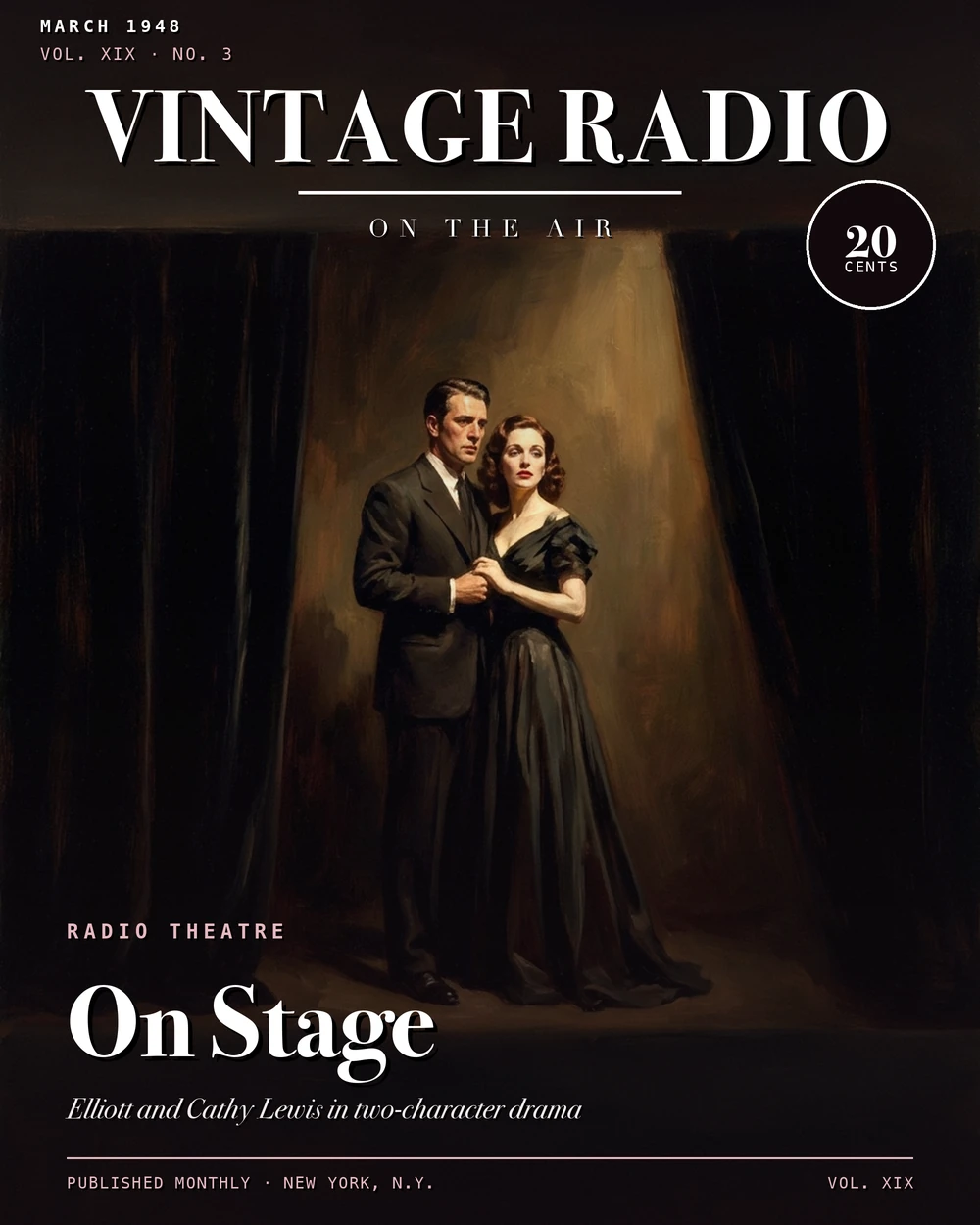
On Stage
Mr. and Mrs. Radio Make Their Show
By 1952, the radio industry had settled on a nickname for Cathy and Elliott Lewis: "Mr. and Mrs. Radio." It wasn't idle flattery. Their combined annual income was reportedly around $90,000, earned across an extraordinary volume of West Coast radio work. Elliott was doing 20 or more shows a week by 1940, had produced roughly 120 programs for the Armed Forces Radio Network during World War II, and by the early 1950s was producing and directing both Suspense and Broadway Is My Beat simultaneously. Cathy was a fixture on Suspense, The Great Gildersleeve, The Whistler, and was playing Jane Stacy on My Friend Irma.
The idea for their own show had been floating around since 1948, when the two appeared together on an episode of The Clock on ABC and someone in the room suggested they should have their own theater. It took four years, but in late 1952 CBS gave them the go-ahead. They formed a production company called Haven Radio Productions — named after their home in Beverly Hills — and set about building the kind of show neither had been able to attempt inside someone else's production. On Stage debuted on January 1, 1953, and ran on CBS until September 30, 1954.
Elliott was born in New York City in 1917, grew up in Mount Vernon, and came to Los Angeles nominally to study law. He ended up at Los Angeles City College studying music and drama instead, made his radio debut at 18 after being noticed in a college production, and by 1939 — which he later called "the beginning of the wonderful decade for radio" — he was fully embedded in the medium. His Manhattan accent gave him range: he could move between comedy, tragedy, and melodrama without strain. Cathy, born Catherine Lee Lewis in Spokane in 1916, had started out as a singer, briefly worked with Kay Kyser's orchestra as a teenager, spent time in Chicago on programs like The First Nighter Program, and came to Hollywood in 1936. They shared a surname without sharing a family tree; a mutual friend introduced them thinking it was funny. They first crossed paths professionally at The Woodbury Playhouse on November 6, 1940, and were married on April 30, 1943, while Elliott was on Army leave.
What the Show Was Trying to Do
On Stage was built around a specific dramatic idea: each episode would put two characters of genuinely equal strength against each other, with the male-female relationship at the center. This wasn't the standard radio setup where one figure drives the story and the other reacts. The Lewises wanted both roles to carry equal weight. The relationship between the two leads shifted from episode to episode — they might be lovers, spouses, friends, family members, strangers, or occasionally outright enemies, depending on the story. What stayed constant was the balance.
The show also made deliberate choices about what it would not be. Elliott was emphatic about avoiding the worn grooves of radio drama: no foreign agents, no newspaper reporters, no private-eye-and-his-girl plots. He was equally opposed to adapting movies for radio, and he said so plainly: "Material written for one medium shouldn't be used on another. How can a story planned for 90 minutes of sight dimension be told in 21 minutes of sound?" That conviction shaped the show's identity. The stories came from a mix of original scripts and adaptations of literary material — mysteries, melodramas, adventures, satires, farcical comedies — but all of it was selected or written for the specific format, not borrowed from somewhere else.
A Broadcast Television review described the Lewises as "experts at underplay," which captures something real about how the show worked. Elliott also wrote the opening and closing of each episode himself and edited individual scripts. Episodes closed with the stars in dialogue and an on-air announcement of the following week's title and writer's name — a detail that reflected both Lewises' broader advocacy for giving radio performers and writers proper credit. They argued publicly: "We think the listeners want to know whom they are hearing on their radios, and if radio isn't willing to build up its own people, it is only hurting itself."
The Writers and What They Brought
The writing staff was one of the show's real strengths. Morton Fine and David Friedkin were core contributors, as was Richard Chandlee. But the two writers who most defined the show's range were E. Jack Neuman and Shirley Gordon, and they worked in nearly opposite registers.
Neuman wrote hard-hitting, controversial material that drew heavy audience mail. His episode "Eddie" is cited as perhaps the first radio drama to depict in graphic terms a woman's vulnerability to a man who forces his way into her life — it generated strong responses both in support and opposition. Another Neuman script, "Statement of Fact," put a ruthless district attorney across the table from a female murder suspect and let the interrogation do the work. Gordon's writing came at things differently, through what was described as a sensitivity to the mysteries of love. Her episode "Call Me a Cab" is a quiet study in loneliness.
Other memorable scripts came from Antony Ellis and, on one notable occasion, from the show's own sound effects man, who wrote the episode "Penny Ante." "The Bear" adapted Anton Chekhov's comedy, with the script by Walter Brown Newman. "Four Meetings" worked from a Henry James tale about a man who crosses paths with the same woman four times across his life. "The Party" was described as a near-perfect slice-of-life, giving a sharp picture of its two main characters against the backdrop of a boozy gathering. "The Public Furlough," written by Antony Ellis, explored the shallow nature of fame in a way one reviewer called sad and haunting. There was also room for lighter work — "Dig the Thief" was a swindle plot played for comedy. The episode "Bunch of Violets" gave Cathy Lewis an unusual challenge: she played all three of the main female roles in the story.
One episode carried a personal note. "The Anniversary," which aired April 30, 1953 — the Lewises' tenth wedding anniversary — told of the ups and downs of married life. Another, "Heartbreak," touched on cardiac themes that would prove prescient; Elliott Lewis faced serious heart trouble in later years and died of cardiac arrest in 1990.
The Production Team Behind the Sound
Elliott Lewis was producer-director throughout the run, a role he had already been honing at Suspense, where he had taken over from William Spier in 1950. He told Newsweek in mid-1953: "I can do things now that I wouldn't dare to do two or three years ago." He kept a motto at his desk drawn from Fred Allen: "Where were you when the page was blank?" — his standard response when executives or sponsors requested last-minute script changes. He was also teaching radio production classes at UCLA during the same period.
Music for the show came from two figures with substantial histories of their own. Lud Gluskin, CBS's Director of Music since 1937, served as conductor. Gluskin had formed a piano-and-drums duo with Jimmy Durante in high school, toured Europe with Paul Whiteman's band, led his own orchestra in Paris and Berlin in the late 1920s and early 1930s, and fled Europe as Nazism took hold. He came to CBS in 1935 and had directed the music for Orson Welles's War of the Worlds broadcast in 1938. He later recommended Fred Steiner for the original Star Trek television series.
Fred Steiner, the show's composer, came from a musical family — his father had studied under Zoltán Kodály — and had studied composition at Oberlin before working in radio, including early credits on Suspense and CBS Radio Workshop. He eventually wrote the Perry Mason television theme ("Park Avenue Beat"), the Rocky and Bullwinkle theme, and contributed more incidental music to the original Star Trek than any other composer. The On Stage theme was called "The Cathy and Elliott Theme," composed by Ray Noble, who also served as composer and conductor for episodes that featured musical performances by Cathy Lewis. George Walsh announced.
The show ran without a sponsor throughout its entire CBS run — a sustained program, funded by the network alone.
The End of the Run, and What Came After
On Stage moved through several time slots during its run — Thursdays at 8:30 through the summer of 1953, then Wednesdays at 9 or 10 through April 1954, then back to Thursdays at 9 for the final months. It ended September 30, 1954. The series ran 78 episodes in total; as of a 2019 archive survey, 41 of those 78 were in circulation. Some surviving recordings are missing their original introductions and closings. The full title and air date record has been documented in Martin Grams Jr.'s Radio Drama: A Comprehensive Chronicle of American Network Programs, 1932–1962; a commercial CD release from Radio Spirits included a program guide by radio historian Karl Schadow.
Before the show ended, the Lewises had already recorded two spoken-word albums — Happy Anniversary (Columbia MC-160) and Happy Holidays — both orchestrated by Ray Noble and derived from On Stage material. Elliott later reported the records never made much money, but he eventually learned that CBS affiliate KMOX in St. Louis played them every year. When On Stage was finishing, the era it inhabited was also closing. Television had shifted the landscape fast, and what was left of network radio at the time also included X-Minus One, Frontier Gentleman, and The CBS Radio Workshop — shows that all shared something with On Stage: work done with unusual freedom, precisely because the commercial pressures that had shaped big-time radio were no longer pressing as hard.
Cathy and Elliott Lewis divorced in 1958, on their fourteenth wedding anniversary. Elliott subsequently married actress Mary Jane Croft, who had been a recurring supporting cast member on On Stage. He went on to produce television — Climax, Kraft Television Theatre, The Lucy Show, The Mothers-In-Law, Petticoat Junction — and in 1973–74 directed The Zero Hour, a Mutual Broadcasting System drama series hosted by Rod Serling. In 1979 he co-created the Sears Radio Theater for CBS. He wrote seven detective novels, all about a character named Fred Bennett, published by Pinnacle Books between 1980 and 1983, and served as a script doctor on Remington Steele. Cathy Lewis continued acting in television and film — a recurring role on Hazel, voice work in two episodes of the original Jonny Quest animated series, supporting parts in The Party Crashers (1958) and The Devil at 4 O'Clock (1961) opposite Spencer Tracy — before her death from lung cancer on November 20, 1968. A biography, Mrs. Radio: The Cathy Lewis Story by Lona Bailey, was published in 2023.